The Bus Stop at the Center of the World: Lessons From Kolkata's Most Crowded Corner
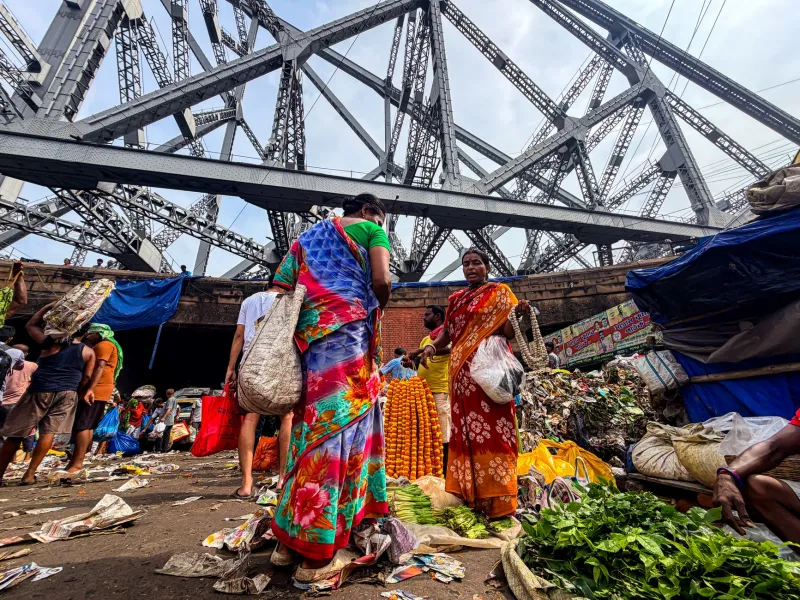
There's a spot in central Kolkata where roughly everything converges at once. Buses belch diesel at the curb, street vendors fan the coals under their kettles, book sellers lay out dog-eared paperbacks on blankets, and somewhere above it all, the trams still grind along their rails like they've got nowhere better to be. The place is called Dharmatala, and if you ask ten people what the name means, you'll get ten slightly different answers — but the one we love most is this: the stopping place of dharma.
A stopping place. Not a destination. Not a checkout button. A place where you pause, whether you meant to or not.
We named this market after that crossroads because we think it holds a truth American shopping culture has mostly forgotten. So let's take the trip.
What a Crossroads Actually Is
Crossroads have always been more than geography. Before interstates and fulfillment centers, the intersection was where civilizations did their real networking. Travelers compared notes on the road ahead. Merchants learned what distant towns were hungry for. Pilgrims and peddlers shared the same cup of tea, and ideas moved the way goods did — hand to hand, face to face.
Dharmatala earned its name because it sat at exactly this kind of junction. It was where you stopped — literally, at the bus terminus — before going wherever you were going. And in that stopping, something happened that no logistics network can replicate: strangers became, briefly, neighbors.
The old woman selling marigolds learned the regulars' stories. The tea stall owner knew which train you were waiting for. Commerce was the excuse; recognition was the product.
What One-Click Buying Gave Us — and What It Took
Let's be fair to the modern conveniences. Same-day delivery has been a lifeline for disabled folks, rural families, and parents of newborns. Nobody's romanticizing the era of driving forty minutes for a specialty ingredient.
But something real got sanded away. When shopping becomes frictionless, it also becomes faceless. The algorithm knows what you want; nobody knows your name. Our purchases happen in isolation, at eleven p.m., in the glow of a phone, and the transaction leaves no trace of relationship behind.
Sociologists have a term for the casual, low-stakes interactions we used to have with strangers — the vendor, the fellow customer, the person who recommended the good mangoes. Those moments are what researchers call weak ties, and they turn out to be surprisingly load-bearing for our sense of belonging. Americans have been losing them for decades, and the loneliness numbers show it.
A crossroads forces you into the company of people who aren't like you. A feed shows you more of what you already chose. That difference, it turns out, is everything.
The Middle Is a Skill
Here's the part we keep coming back to. In a polarized country, 'meeting in the middle' sounds like a political compromise — a grudging deal. But the crossroads model suggests something different: the middle isn't a compromise you make, it's a place you go, and going there is a practice.
At Dharmatala, nobody agrees on much. Different languages, different faiths, different destinations. The crossroads doesn't resolve any of that. It just puts everyone in the same square long enough to share a sidewalk, a price negotiation, a cup of chai. Tolerance isn't the goal there; it's the byproduct of proximity.
American shopping, by contrast, is engineered for sameness. We self-sort into zip codes, brand tribes, and algorithmic bubbles. The marketplace used to be one of the few civic spaces where difference was ordinary. Rebuilding that takes intention now.
Building Crossroads Moments Into Your Buying Life
You don't need a ticket to West Bengal to shop like you mean it. You need friction — the good kind. A few ways to start:
Choose one purchase a month to make slowly. Buy the thing in person, from a person. Ask where it came from. Let the transaction take twenty minutes instead of twenty seconds.
Show up to the same market regularly. The magic of Dharmatala isn't novelty — it's repetition. The third time you buy tomatoes from the same vendor, you're no longer strangers.
Join or start a swap. Little free pantries, clothing swaps, tool libraries — these are crossroads infrastructure, and they run on neighbors, not capital.
Buy online deliberately, from people you can name. When you do shop online, choose platforms and makers where you know who's on the other end. A purchase can still carry a relationship inside it.
Talk to the stranger in line. It's the smallest crossroads there is, and it counts.
The Stopping Place
We won't pretend a buying habit can fix a loneliness epidemic or a fractured civic culture. But practices shape people, and people shape communities — and the crossroads, in Kolkata or Cleveland, has always been where that shaping happens.
Dharma, at its root, is about the way things hold together. A stopping place of dharma is a place where, for a moment, things hold together: strangers, goods, stories, roads.
So consider this your permission to slow the cart down. Linger at the stall. Learn the vendor's name. Let the market be what it was always meant to be — not the fastest way to get a thing, but one of the last places left where we meet.