The Weekly Pilgrimage: Why Your Saturday Market Run Might Be Doing More for Your Soul Than Your Phone Ever Could
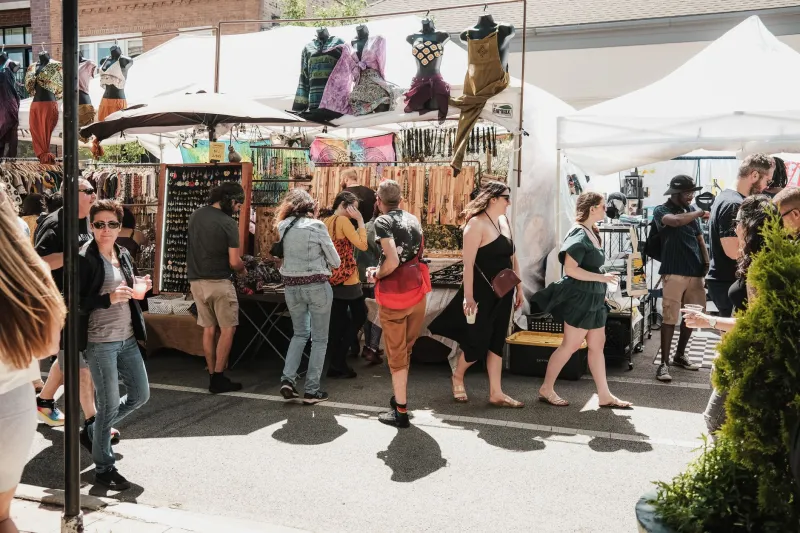
There's a moment that happens at the Saturday market on the edge of my neighborhood — the one with the bentwood chairs and the guy who sells single-origin honey out of a station wagon — that I've started to recognize as something close to holy.
A woman picks up a bar of soap, holds it to her nose, closes her eyes. The soap maker, an older man with flour on his apron, waits. Not impatiently. He's done this a thousand times. She breathes in, nods, and hands him a crumpled ten. He tells her about the lavender farm two counties over. She tells him about her garden. Money changes hands, and so does something else.
Nobody at that market would call it church. But watch long enough and you might.
The congregation that shows up at 9 a.m.
A lot of ink has been spilled about the rise of the "spiritual but not religious" American — roughly a third of us now, by most surveys — and what we've supposedly lost by leaving organized worship. The pews emptied. The buildings became breweries and condos. And the ritual-shaped hole in the week just... sat there.
Except maybe it didn't sit empty. Maybe it filled up with something most of us never thought to name.
Consider what the weekly market actually offers: a fixed time, a shared place, a repeated set of small actions performed in the company of strangers who become, over months and years, familiar faces. Greeting the ceramicist you've bought mugs from for three years. Knowing which stall has the good peaches this week. Standing in line behind someone and hearing about their daughter's wedding.
Sociologists call this "thick community." Religious traditions call it congregational life. Most of us just call it Saturday.
Ritual lives in the senses, not the sermon
Here's what a screen can never give you: the smell of bread before it's wrapped, the weight of a tomato chosen by hand, the particular sound a crowd makes when it's browsing rather than rushing.
Market-going is an entirely embodied practice. You arrive, and the first thing that happens is sensory overload of the gentlest kind — coffee roasting somewhere to your left, a kid fiddling with a wind chime, heirloom squash arranged like an offering. Every purchase requires you to be present. You can't buy a bouquet from a distracted daze; you have to look, compare, decide. Choosing with intention is the whole game.
Compare that to the checkout flow of a mega-retailer: one click, no faces, done in four seconds and forgotten in two. One of these transactions involves a human being looking you in the eye. The other involves an algorithm guessing what you'll want next.
When you exchange money face-to-face — when you hand a maker cash for something they made with their hands — the transaction stops being extractive and becomes relational. That's not a metaphor. That's literally what's happening.
The rhythm argument
There's a quieter case to make here, and it's about time.
Modern American life has flattened the week into an undifferentiated smear. Tuesday feels like Thursday feels like Sunday. The one thing that reliably punctuated the week for generations — a day of rest, a shared gathering — has mostly dissolved, and into the gap rushed the infinite scroll. The average American now spends well over four hours a day on their phone, much of it in that bleary weekend limbo between errands and existential dread.
A weekly market visit re-imposes a shape on the week. It gives you something to anticipate, a deadline for meal planning, a reason to walk somewhere before ten. It anchors you in a season — asparagus means spring, the first apples mean fall — in a way no delivery app ever will.
And crucially, it's a ritual that asks something of you. You have to get dressed. You have to leave the house. You have to make small talk with the mushroom guy. Doomscrolling asks nothing and gives less.
A caveat, because we owe you one
Let's not over-romanticize this. Markets can be expensive in ways that big-box stores aren't, and food access is a real equity issue — not every neighborhood has a Saturday stall scene, and not every family can pay eight dollars for a dozen eggs. A market ritual that becomes a status symbol is just another form of spiritual performance.
And commerce is commerce. Not every vendor interaction is transcendent; sometimes you're just buying radishes. The point isn't that the market is a magic cathedral. It's that ordinary exchange, done with attention and in community, carries more meaning than we've been trained to see.
Try it once, properly
If your weekends already blur together, here's a low-stakes experiment: pick one market morning this month and treat it like an actual ritual.
Go without a list. Walk the whole thing before buying anything. Talk to at least one maker about their work. Buy one thing you chose slowly, for no practical reason — a candle, a jar of pepper jam, a print from someone's folding table. Then bring it home and put it somewhere you'll see it.
That object will carry a story in a way nothing in your cart ever does. And the hour you spent gathering it? That was the practice. That was the service.
No hymns required.