Where the Sacred and the Market Meet Again: The Ancient Logic Behind Intentional Commerce

Photo by Photo by Zoshua Colah on Unsplash on Unsplash
Something Old Is Happening in a New Way
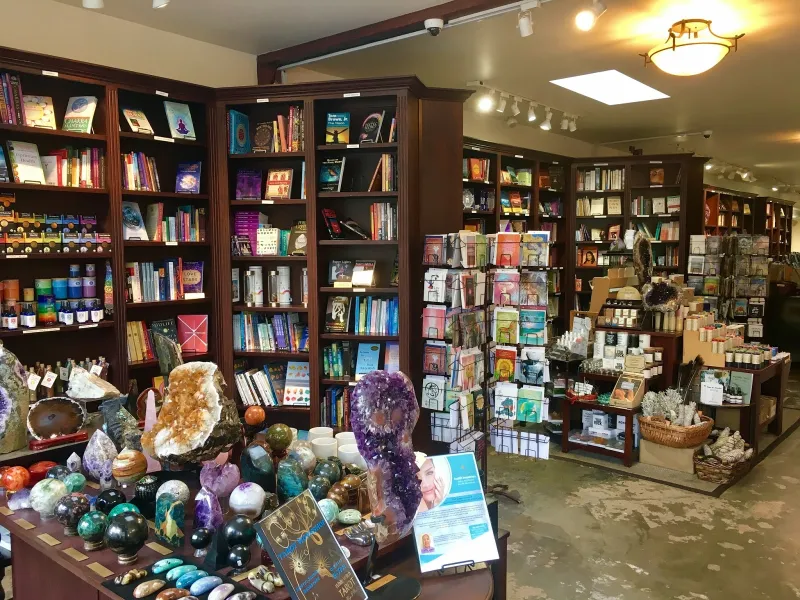
If you've ever walked into a small, carefully curated shop — the kind where incense is burning, where every item on the shelf seems to have been chosen with some kind of intention — and felt something shift in your chest, you're not imagining things. That feeling has a history. A long one.
The word dharmatala comes from a Bengali tradition of crossroads gathering — a place where merchants, pilgrims, teachers, and neighbors converged not just to buy and sell, but to exchange ideas, receive blessings, hear music, argue philosophy, and generally do the messy, sacred work of being a community together. Commerce wasn't separate from spiritual life. It was spiritual life, at least in part. The marketplace was a site of meaning-making, not just transaction.
For most of modern American retail history, that idea got completely flattened. The logic of efficiency and scale took over, and shopping became something you did as fast as possible, ideally without talking to anyone. The soul of the marketplace — the part that fed something deeper than a shopping cart — got squeezed out.
But something is shifting. Slowly, then all at once, a different kind of commercial space has been emerging. And it's worth asking: what exactly is it trying to be?
The Pilgrimage Impulse Doesn't Go Away
Humans have always traveled toward meaning. Whether it's a medieval journey to a holy site, a road trip to a music festival, or a Sunday morning drive to the farmers market, we seek out places that feel charged — where the ordinary rules of daily life seem to soften a little and something more alive takes their place.
Conventional retail never quite scratched that itch, and honestly, it wasn't trying to. But the rise of intentional marketplaces — both physical and digital — suggests that a significant portion of the American public is hungry for commercial spaces that do more than process transactions. They want to arrive somewhere. They want the act of finding and choosing and purchasing to feel like it means something.
This isn't nostalgia. It's a response to a real absence. When community infrastructure erodes — when churches empty out, when third places disappear, when neighbors stop knowing each other's names — people start looking for belonging wherever they can find it. And sometimes they find it while shopping for a hand-thrown ceramic mug or a small-batch herbal tincture from an artisan three states away.
Curation as a Spiritual Act
One of the things that distinguishes an intentional marketplace from a conventional one is the role of the curator. In a dharmatala-style space, the person or platform doing the selecting isn't just optimizing for margin or search ranking. They're making choices based on values — about ethics, sourcing, cultural respect, ecological impact, and the lived integrity of the people making the goods.
That kind of curation requires discernment. It requires asking questions that most retail systems aren't built to ask: Who made this? Under what conditions? Does this product belong to a tradition that has been harmed by commercialization, or does it come from makers who are genuinely part of that tradition? Is this beauty extracted or offered?
When a marketplace does that work seriously, it creates a kind of trust that's hard to manufacture. Buyers start to feel that the space itself has their back — not just in a customer-service sense, but in a values sense. They're not navigating alone. Someone has already done the discerning, and they can step into that with some confidence.
That's not so different from what a pilgrimage site historically offered: a space that had already been consecrated, already prepared, so that visitors could arrive and simply be present.
The Seller's Side of the Equation
It's easy to talk about what intentional marketplaces offer buyers. But the transformation is just as significant — maybe more so — for the people on the other side of the exchange.
For independent artisans, herbalists, sacred goods makers, and small spiritual entrepreneurs, conventional commerce has always been a rough fit. Etsy started with promise and gradually became another algorithm-driven race to the bottom. Amazon is essentially off the table for anyone whose work can't be mass-produced. And building a standalone e-commerce presence from scratch requires marketing skills and capital that most small makers simply don't have.
A values-aligned marketplace offers something different: a community context for the work. When a candle-maker or a mala bead artisan or a Reiki practitioner joins a platform that's organized around shared principles, they're not just getting a storefront. They're joining a conversation. Their work is seen in relation to other work that shares a similar orientation. The context itself communicates something that no individual product description quite can.
This matters because so much of what's being sold in these spaces isn't really just a thing. It's a transmission of some kind — a practice, a lineage, a way of paying attention. The marketplace that understands that becomes more than a sales channel. It becomes a community infrastructure.
Commerce as Ritual, Not Just Routine
One of the more radical ideas embedded in the dharmatala concept is that the act of exchange itself can be sacred. Not the product. Not the spiritual credentials of the buyer or seller. The exchange — the moment when something passes from one person to another, carrying intention and care and acknowledgment.
In most modern retail, that moment has been engineered out of existence. One-click purchasing, automated fulfillment, frictionless checkout — these are explicitly designed to make the act of buying as unconscious as possible. The goal is to remove any pause that might interrupt the conversion.
Intentional commerce works against that current. It slows things down on purpose. It invites the buyer to read the maker's story, to understand where a product comes from and why it was made. It creates small moments of pause and consideration that, accumulated over time, start to feel like a practice — a way of moving through the material world with more awareness than the default setting offers.
This is what makes a dharmatala-style marketplace feel like a pilgrimage site rather than a store. The journey to find the thing, understand it, choose it deliberately, and receive it — that whole arc has a ritual quality. Something in us recognizes it.
What We're Actually Building
The growth of conscious commerce platforms in the US isn't a trend, exactly. It's more like a correction — a cultural immune response to decades of extraction-based retail that left both buyers and sellers feeling hollowed out.
When people gather in spaces built around shared values, where the act of buying and selling is woven into a larger fabric of meaning, something old gets reactivated. The crossroads comes alive again. The dharmatala reasserts itself in whatever form the present moment allows.
That's worth paying attention to. Not because it's perfect — these spaces are built by humans, and they carry all the contradictions and blind spots that implies — but because the impulse behind them is real and ancient and, it turns out, pretty persistent.
We keep coming back to the place where the sacred and the market meet. Maybe that says something important about what we actually need from each other.