Smoke Signals: What Your Incense Label Is Actually Telling You (and What It's Hiding)
Stand in the incense aisle of almost any American health food store and you'll spot it immediately: the word natural, printed in a soothing sage-green font, on a box that tells you absolutely nothing else. No ingredient list. No origin. No maker. Just vibes, boxed and shrink-wrapped.
We sell incense at Dharmatala Market, so believe us when we say we understand the temptation to let the label do the meditating for you. But if you're burning something in your home — inhaling it, actually — you deserve to know what's in it. And the industry, for the most part, is counting on you not to ask.
Here's how to start asking anyway.
The Words That Mean Nothing (Legally)
The Federal government does not require full ingredient disclosure on fragrance products. That loophole is the entire business model of a lot of what's on the shelf.
Watch for these green-light words that are actually yellow flags:
- "Natural" — an unregulated marketing term. Petroleum-derived fragrance can legally sit behind this word.
- "Essential oil infusion" — often means a drop of the real thing floating in synthetic fragrance oil.
- "Aromatherapy" — not a regulated claim. A candle can call itself aromatherapeutic because it smells like lavender.
- "Clean" — no legal definition, no standard, no enforcement. It's a font choice.
Meanwhile, the words that do signal something are usually boring: a named botanical (santalum album, not "sandalwood scent"), a named origin (Karnataka, India; Oaxaca, Mexico), and a maker who answers email.
What's Actually in That Stick
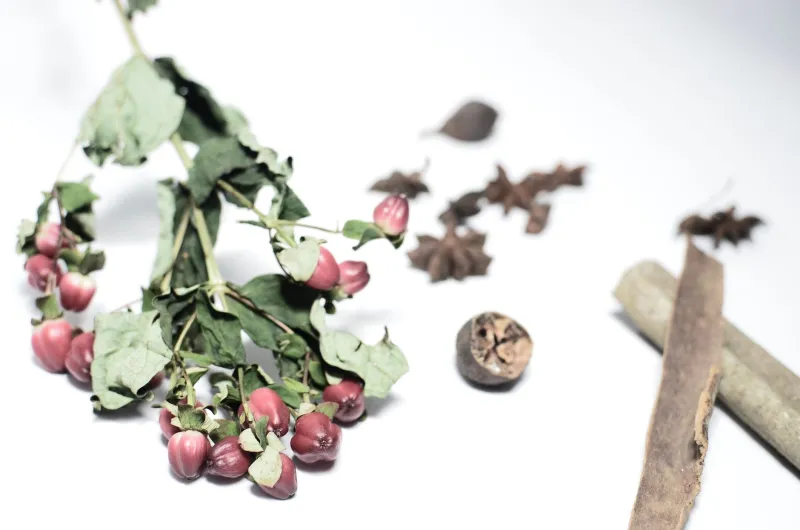
Traditional masala incense — the style made across much of India and Nepal — is essentially a paste of ground botanicals, a binder like gum arabic or honey, and a bamboo stick. Good ones list or can name their materials: sandalwood powder, dried flowers, resins like frankincense or myrrh.
The mass-market alternative is a dipped stick: charcoal or sawdust base soaked in synthetic fragrance oil and a combustible. That's why a $2.99 box of "Nag Champa" at the gas station smells the same stick after stick, and why your head aches after burning it. Synthetic fragrance isn't automatically dangerous, but it's not what the label implies, and combustion changes the chemistry of what you breathe.
The same logic applies to candles (look for actual wax type — soy, beeswax, coconut — and named fragrance disclosure) and essential oils ("lavender oil" vs. "lavender fragrance oil" is the difference between a plant and a lab).
A Maker Tells Us What the Label Can't
We called Maya Reyes, who hand-rolls small-batch incense in Asheville, North Carolina, and sells at regional markets under the name Smoke & Cedar. We asked the question most shoppers never get to: what does honesty cost?
"A kilo of genuinely good Mysore sandalwood powder runs me around $180, sometimes more," she told us. "A synthetic sandalwood fragrance oil? Maybe $12 for the same volume. My sticks cost $14 for ten. The dipped ones wholesale for a dollar a bundle. People ask why mine are 'expensive,' and I walk them through the math. After that, they usually get it."
Reyes also pointed out that her actual ingredient cost is a third of her price — the rest is labor, since each stick is rolled by hand. "The label can't hold all that," she said. "That's why I put my phone number on the box."
That's the tell, honestly. Makers with nothing to hide tend to be reachable.
The Five-Minute Label Check
Before you buy, run the product through this quick audit:
- Named botanicals or nothing. Does the label name specific plants, resins, or woods — or just moods ("tranquility," "ocean breeze")? Moods are marketing; plants are ingredients.
- A place of origin. Real supply chains have geography. "Blended in USA" with no source country for the botanicals is a dodge.
- A maker you can contact. A brand website with a human name, a small-batch statement, or an ingredient FAQ beats a trademarked logo every time.
- Price that matches the claim. Genuine sandalwood, frankincense, and rose otto are expensive raw materials. A suspiciously cheap "pure" version of an expensive thing is usually lying about something.
- **Certifications, used sparingly."" There's no gold-standard certification for incense the way there is for coffee or chocolate, so treat third-party seals as a bonus, not a baseline. The absence of a seal means little; the absence of an ingredient list means a lot.
Burn It Like You Mean It
None of this means you need to toss your drugstore sticks tonight or spiral into ingredient anxiety every time you want your living room to smell nice. It means treating incense like what it is — something you put into your body and your home — and letting that awareness shape the purchase.
Start with one swap. Find one maker, ask one question, read one label all the way through. The practice of paying attention is the practice. The smoke is just how you notice it.