The Altar You Actually Need: Building a Home Sanctuary That's Real, Not Staged
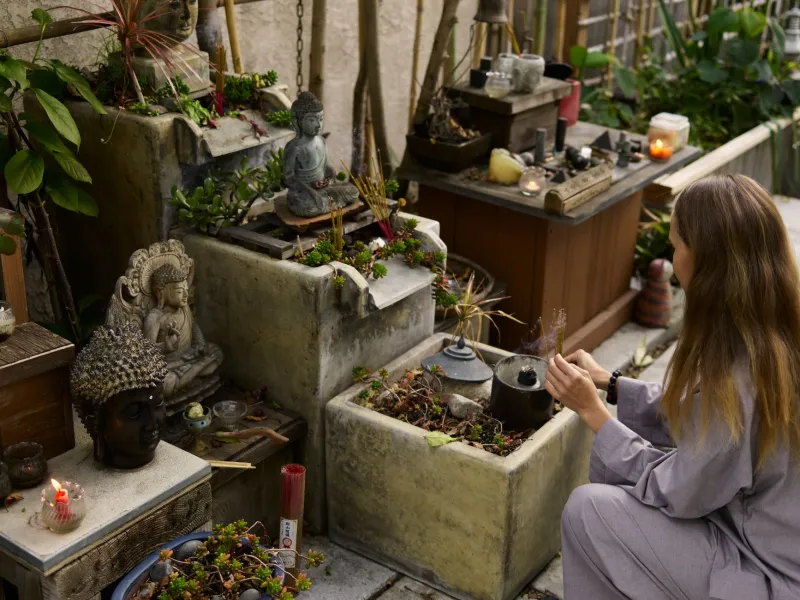
Be honest. Is your meditation corner a place you actually meditate, or is it a place you photographed once and then slowly let become a surface for mail?
No judgment. It happens to almost everyone who tries to build a spiritual space at home — and it happens for reasons that are worth understanding before you rearrange anything else.
The problem usually isn't the stuff. It's the intention underneath the stuff, or more precisely, the absence of it.
Why Most Home Altars Don't Work
We live in an era of extraordinary visual inspiration and very little guidance on what any of it actually means. Pinterest and Instagram have given us thousands of images of serene, artfully arranged altars — the selenite tower, the hand-knotted mala, the perfectly placed plant — and almost no context for why any of those objects might matter.
So people build spaces that look like spiritual spaces without asking the more important question: spiritual for whom, and toward what end?
"The first altar I built was basically a mood board," admits Tomás Rivera, a schoolteacher in Albuquerque who has practiced a blend of indigenous Mexica traditions and contemporary meditation for over a decade. "It looked great. It meant nothing to me personally. I hadn't asked myself what I actually believed, what I was actually trying to do when I sat down there."
That's the real starting point. Not "what should go on my altar" but "what is this space actually for?"
The Appropriation Trap (and How to Sidestep It)
Here's a pattern that shows up constantly in American spiritual home design: someone discovers a tradition they find beautiful — Tibetan Buddhism, Yoruba-inspired altars, Shinto aesthetic principles, Día de los Muertos imagery — and incorporates its symbols without any real relationship to the tradition itself.
This isn't always malicious. Often it comes from genuine admiration. But admiration isn't the same as understanding, and a symbol removed from its context can become something hollow at best, disrespectful at worst.
"A Ganesha statue isn't just decor," says Ananya Krishnamurthy, a Hindu educator and community organizer in Houston. "In our tradition, if you have Ganesha in your home, there are practices associated with that — offerings, specific prayers, a relationship. When I see him in someone's entryway next to a succulent with no acknowledgment of what he represents, it stings a little. Not because I want people to stay away from my tradition, but because he deserves more than that."
The alternative isn't to avoid all objects from traditions outside your own. It's to engage with them honestly — to learn, to build relationship, to ask permission where appropriate, and to acknowledge what you're drawing from. A small card or note in your own journal naming where an object comes from and why you hold it is more spiritually meaningful than you might think.
Anchor It to Practice, Not Aesthetics
The most functional sacred spaces — the ones that people actually use consistently — are designed backwards from practice, not forward from appearance.
Start with the question: what do I actually do here?
If you meditate, your space needs to support stillness. That might mean a cushion at the right height, minimal visual distraction, and objects that help you arrive rather than objects that demand your attention.
If you pray, you probably need a focal point — something that helps direct your attention outward or inward, depending on your tradition. That might be an image, a flame, a photograph of someone you love, or simply an empty bowl representing receptivity.
If you journal or do reflective writing, the space might center around good light, a comfortable seat, and objects that evoke the themes you're working with.
"I tell people: don't buy anything for your altar until you've sat in the empty space for a week," says Kezia Monroe, a spiritual director and interfaith chaplain based in Atlanta. "Figure out what the space feels like without objects. Notice what it naturally calls for. Then let objects come in slowly, one at a time, only when you know what they're for."
What Actually Makes a Space Feel Sacred
Across traditions — from Catholic home shrines to West African ancestor altars to Buddhist meditation rooms to Jewish mezuzah-marked doorways — a few principles show up consistently in spaces that people describe as genuinely sacred rather than merely spiritual-looking.
Threshold. Sacred spaces work partly because they're demarcated. There's a transition — physical, sensory, or ritualistic — between ordinary space and this space. It might be as simple as removing your shoes, lighting a candle, or ringing a small bell. The threshold tells your nervous system: something different happens here.
Liveness. Many traditions include living or perishable elements on altars — fresh flowers, water, food offerings, candles, incense. These elements require tending. That tending is the practice. A space you never have to interact with is a space that slowly dies.
Personal resonance over cultural cachet. A photograph of your grandmother, a stone from a place that changed you, a handwritten note from a difficult time you survived — these objects carry your actual history. They mean something. Often they're more powerful than any purchased sacred item.
Impermanence. Some of the most powerful spiritual spaces are deliberately temporary. The Tibetan sand mandala is destroyed after completion. Día de los Muertos altars are dismantled after the holiday. Building and releasing teaches something that permanent display cannot.
Real Spaces, Real Stories
Lena Park, a Korean American therapist in Seattle, describes her space as "deliberately small." It's a single wooden shelf with a photograph of her late mother, a small bowl she fills with water each morning, and a candle. "Nothing on it is Instagram-worthy," she says. "But when I sit in front of it, I feel held. That's all I needed it to do."
Devon Okafor, a Yoruba practitioner in Brooklyn, maintains a more elaborate ancestral altar that includes offerings, specific colors, and ritual objects with precise meaning in his tradition. "Mine isn't a starting point for beginners," he says, laughing. "I've been building relationship with these practices for years. The altar reflects that relationship. It's not decoration — it's a living conversation."
Both spaces work. Neither looks like the other. That's the point.
A Few Practical Starting Points
If you're beginning or rebuilding, here's a simple framework:
- Clear the space first. Literally and energetically. Clean the surface, sit with it empty, let it breathe.
- Choose one anchor object that has genuine personal meaning. Build outward from that.
- Add something living — a plant, a candle, fresh water. Commit to tending it.
- Create a threshold ritual, however small. It doesn't need to be elaborate. It needs to be consistent.
- Let it evolve. A good altar changes over time because your practice changes over time. If yours has looked the same for three years, it might be telling you something.
The goal isn't a space that looks sacred. It's a space that makes you feel like showing up — to yourself, to your practice, to whatever you understand the sacred to be.
That's a different design problem than Pinterest has ever tried to solve. Fortunately, it's one you're entirely equipped to figure out yourself.