More Than a Marketplace: How Online Platforms Rooted in Shared Values Are Becoming the New Sacred Spaces
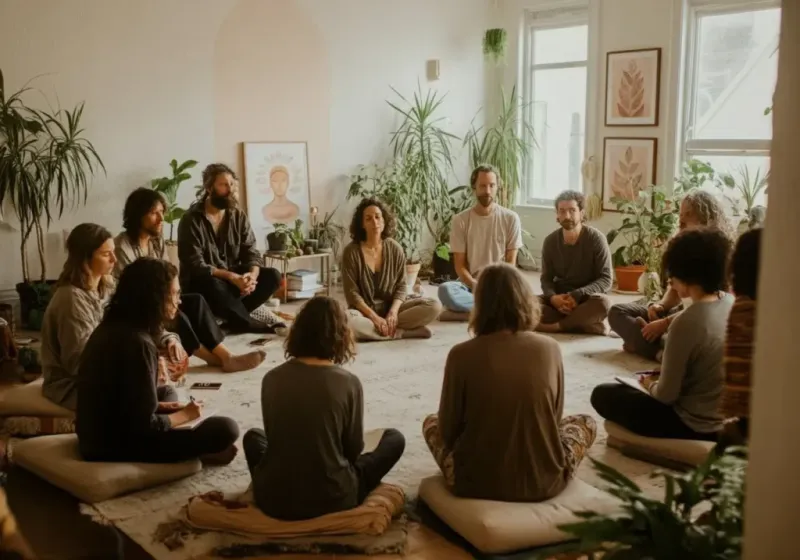
Photo: diverse spiritual community online small business artisan vendor connection, via www.7chakracolors.com
Nobody logs onto a marketplace expecting a spiritual awakening. You're there for the mala beads, the beeswax candles, the hand-thrown ceramic mug you've been eyeing for weeks. But something funny keeps happening in the corners of the internet where conscious commerce lives: people keep finding each other.
Not just as buyers and sellers. As community.
In a cultural moment defined by algorithmic isolation, doom-scrolling, and the hollow performance of connection on mainstream social media, niche marketplaces built around shared values are quietly doing something remarkable. They're creating digital gathering places where the act of buying and selling becomes secondary to something more profound — belonging.
The Limits of the Big Box Internet
To understand why this matters, it helps to think about what the dominant e-commerce experience actually feels like. You land on a massive platform. You're served products based on your behavioral data. You check out. An algorithm notes your purchase and serves you seventeen similar items within the hour. There's no story, no face, no relationship. Just frictionless transaction.
For a lot of Americans, that efficiency is fine for buying paper towels. But when you're looking for a hand-carved altar piece, a bundle of ethically wildcrafted herbs, or a piece of jewelry made by a Lakota silversmith — you want something different. You want context. You want connection. You want to know that the thing you're bringing into your home carries meaning beyond its price tag.
This is the gap that community-centered platforms are stepping into. And it turns out the gap is enormous.
What Makes a Marketplace "Conscious"?
The term gets thrown around a lot, so let's be specific. A conscious marketplace isn't just one that sells wellness products or uses words like "sacred" and "intentional" in its copy. Those are aesthetic choices, not values.
A genuinely conscious marketplace is one where the structure reflects its stated principles. That means vetting vendors not just for product quality but for ethical sourcing and authentic practice. It means centering storytelling — letting makers share who they are, where they come from, what their craft means to them. It means building in opportunities for community interaction beyond the checkout page: forums, events, shared rituals, educational content.
And perhaps most importantly, it means resisting the growth-at-all-costs logic that hollows out most platforms over time. Staying niche, staying curated, staying accountable to a community rather than to venture capital metrics.
Real Stories from the Digital Dharma
We heard from Maya, a reiki practitioner in Portland, Oregon, who started selling her hand-blended ritual oils on a small conscious marketplace two years ago. She expected to move some inventory. What she didn't expect was the community.
"The platform had a forum where vendors and customers could actually talk," she said. "I started getting messages from people asking about my practice, sharing their own experiences with energy work. Some of them became regular clients. One of them became a close friend. I've never had that on a big platform."
Then there's David, a retired schoolteacher in Asheville, North Carolina, who started buying from small spiritual vendors after his wife passed away and he found himself drawn to Buddhist practice for the first time. "I wasn't just shopping," he told us. "I was building an altar, building a practice, building a whole new way of understanding my life. And the vendors I connected with — they got that. They were on the same path."
These aren't outliers. Across conscious commerce platforms, the pattern repeats: people show up for products and stay for the people.
The Power of Story in a Skeptical Age
One of the most significant things these platforms get right is the role of narrative. In an era of deep consumer skepticism — where greenwashing is rampant and "handmade" often means assembled in a warehouse — story is the new currency of trust.
When a vendor on a conscious marketplace tells you that her grandmother taught her to weave, that each piece takes three weeks to complete, that the dyes she uses come from plants she grows herself — you're not just getting product information. You're getting a relationship. You're being invited into a lineage.
This is ancient technology, actually. Before advertising, before branding, before e-commerce, the way humans decided whether to trust a maker was by knowing them, by understanding their story, by seeing their work embedded in a community that vouched for them. Niche platforms are digitally reconstructing that ancient logic.
Building the Commons, One Purchase at a Time
There's a political dimension to this worth naming, too. The rise of conscious commerce platforms is, in part, a response to the concentration of economic power in a handful of mega-corporations. Every dollar spent on a community-centered marketplace is a dollar that doesn't go to a platform that extracts value from workers, suppresses small sellers, and optimizes for engagement over wellbeing.
For a lot of the shoppers and vendors we spoke with, that's a meaningful choice — not a sacrifice. They're not giving something up by shopping small and intentional. They're getting something back: the sense that their economic activity is aligned with their values, that their spending is an act of solidarity rather than just consumption.
This is what dharma in commerce actually looks like. Not a logo, not a mission statement — but a lived practice of choosing relationships over convenience, meaning over efficiency, community over scale.
What We're Building at Dharmatala Market
This is the vision that animates everything we do here. We're not trying to be everything to everyone. We're trying to be the right thing for people who are done with the hollow transaction — who want their shopping to be part of a larger practice of intentional living.
Every vendor we work with is someone whose story we believe in, whose craft we respect, whose values align with the community we're building together. Every customer who finds us is a potential neighbor in this digital village we're growing.
The marketplace is the mechanism. The community is the point.
And if you've read this far, there's a good chance you already know what we're talking about — that feeling of finding your people, of landing somewhere on the internet that actually feels like home. That's what we're here for. Pull up a chair.