Together Again: How Communal Rituals Are Quietly Mending America's Loneliness Crisis
Photo: Couch-scratching-cats, Public domain, via Wikimedia Commons
The US Surgeon General called it an epidemic. Researchers have compared its health risks to smoking fifteen cigarettes a day. And yet, for all the headlines and think pieces, the solution to loneliness rarely makes the front page — because it's quiet, slow, and doesn't come in a pill bottle.
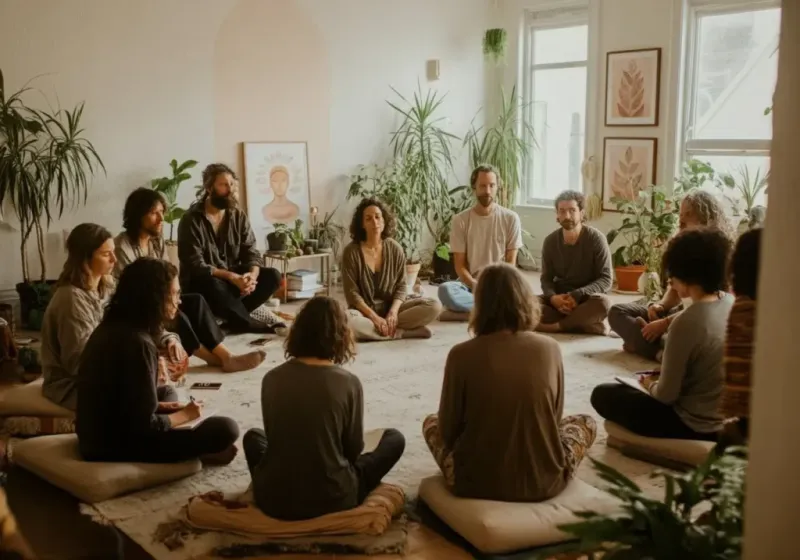
It looks more like a circle of people sitting on cushions in someone's living room in Portland, breathing together. Or a group of strangers in Chicago drumming in a park until their hands hurt and their hearts open. Or a handful of neighbors in New Mexico gathered around a low table, watching steam rise from a shared bowl of tea.
These aren't quirky hobbies. They're rituals. And there's growing evidence — both scientific and deeply human — that they're doing something our hyper-connected, chronically isolated culture desperately needs.
What the Science Is Actually Saying
Neuroscientists and social psychologists have been circling this territory for years, and the findings keep pointing in the same direction: synchronized group behavior does something measurable to the human brain and body.
When people move together, breathe together, or even just maintain shared rhythm — think call-and-response chanting, collective drumming, or synchronized movement — the brain releases a cocktail of neurochemicals that includes oxytocin (the bonding hormone), endorphins, and serotonin. Dr. Robin Dunbar, an evolutionary anthropologist at Oxford, has studied how communal rituals function as what he calls "social glue" — mechanisms that our species evolved specifically to bond large groups of unrelated individuals.
In simpler terms: ritual is a technology. An ancient one. And we've largely stopped using it.
America's social architecture has quietly dismantled many of the structures that once made communal ritual a default part of life — neighborhood churches, union halls, front porch culture, intergenerational households. What replaced them was convenience, screens, and the myth that individual fulfillment was the whole point.
Spoiler: it wasn't.
The Practitioners Filling the Gap
Across the country, a loose but growing movement of facilitators, healers, and community organizers is building new containers for old practices — and the people showing up are not who you might expect.
María Solís, a somatic therapist based in Los Angeles, runs what she calls "grief circles" — monthly gatherings where participants come together to acknowledge loss, transition, and the weight of living in hard times. "There's no fixing in the circle," she says. "People aren't there to solve each other's problems. They're there to witness. And witnessing is one of the most healing things a human being can do for another."
In Atlanta, a community drummer named Kwame Asante has been leading West African-style drum circles for nearly a decade. He started in a church basement with eight people. Now his gatherings draw sixty or more. "The drum doesn't let you stay in your head," he explains. "Your body has to show up. And when your body shows up, you're actually present with other people — maybe for the first time all week."
Then there's the tea ceremony revival. Practitioners of gongfu cha and Japanese chado are adapting these traditions for American living rooms, stripping away the gatekeeping and focusing on what makes the practice powerful: slowness, attention, and shared presence. A cup of tea prepared with intention and offered with care is a radical act in a culture of grab-and-go.
Why Ritual Works When Other Things Don't
Therapists who work with loneliness and social anxiety often note something interesting: their clients don't just need more social contact — they need meaningful social contact. And ritual provides a structure that takes the pressure off.
"When people don't know how to connect, ritual gives them a script," says Denver-based therapist Joanna Park. "You don't have to figure out what to say or how to be. The practice holds you. That's actually really freeing for people who feel awkward or anxious in social settings."
This is part of why ancient traditions like communal meditation, singing circles, and seasonal ceremonies have survived for thousands of years across radically different cultures. They're not just spiritually meaningful — they're socially functional. They create belonging without requiring anyone to be particularly charming or articulate.
Rituals You Can Actually Start This Week
You don't need a guru or a perfectly curated space to begin. Here are a few accessible entry points:
The shared meal with intention. Before eating together, take sixty seconds of silence. Light a candle. Let someone say something they're grateful for. It sounds small. It isn't.
A monthly moon gathering. Invite four to six people to your home on or near the full moon. Sit in a circle. Each person shares one thing they're releasing and one thing they're calling in. No cross-talk, no advice. Just listening.
A walking ritual. Gather neighbors or friends for a weekly walk — same time, same route. No earbuds. The rhythm of walking together is itself a form of synchrony, and regularity is what turns a hangout into a ritual.
Communal sound. Find a local drum circle, kirtan, or sound bath and go — not once, but consistently. Community is built through repetition.
The Bigger Picture
What's happening in these circles and ceremonies isn't just personal healing. It's a kind of cultural reclamation. People are recognizing that the antidote to fragmentation isn't more content or more followers — it's actual presence, actual bodies, actual shared breath.
At Dharmatala Market, we've watched this shift happen in real time. The products people seek out most aren't just beautiful objects — they're tools for practice. A singing bowl isn't decoration. A hand-thrown tea set isn't just dishware. They're invitations to slow down, gather, and remember what we're actually here for.
The loneliness epidemic is real. But so is the hunger to fix it — and people are finding their way back to each other, one ritual at a time.