Beyond Fair Trade: What It Really Means to Buy From an Artisan — and How to Know If You Actually Are
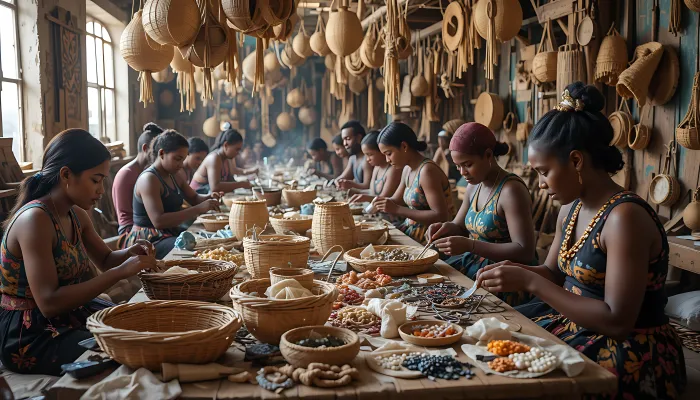
Photo: artisan craftsperson handmade goods fair trade workshop ethical sourcing, via img.pikbest.com
Let's be honest about something: most of us who care about ethical shopping have, at some point, grabbed something with a "fair trade certified" sticker and felt pretty good about ourselves. And that's not entirely wrong — fair trade certification was a genuine leap forward from the race-to-the-bottom labor practices that defined global manufacturing for decades.
But here's what the label doesn't tell you: who made it, whether they're thriving or just surviving, whether the community around them is better off, or whether the trade relationship is designed to last. Fair trade set a floor. A growing movement of artisans, sourcing advocates, and conscious consumers is now asking what the ceiling looks like.
They're calling it reciprocal trade. And it's a fundamentally different way of thinking about what happens when you buy something handmade.
The Problem With "Ethical Enough"
Fair trade certification — the kind you see on coffee, chocolate, and some textiles — operates on a compliance model. Brands pay to be audited against a set of labor and environmental standards, and if they pass, they get the label. It's better than nothing. But it's also a minimum threshold, not a vision.
Direct trade, a model that originated in the specialty coffee world, cut out the middlemen and created direct financial relationships between roasters and farmers. More money to the producer, more transparency for the consumer. Progress.
But reciprocal trade goes further still. It asks not just whether a maker was paid fairly, but whether the relationship between buyer and maker is actually mutual. Does the buyer understand the cultural context of what they're purchasing? Does the maker have input into how their work is presented and sold? Does the trade relationship support the broader community — not just the individual artisan?
"Fair trade asks: did we follow the rules?" says Amara Diallo, a textile sourcing advocate who works with West African weavers and US-based retailers. "Reciprocal trade asks: are we in right relationship? Those are very different questions."
What Extraction Actually Looks Like
Extractive trade is easy to spot at the extremes — sweatshop labor, stolen cultural designs, poverty wages. But it gets murkier in the middle, and that's where a lot of well-meaning consumers get tripped up.
Consider the "handmade" marketplace ecosystem. A product can be technically handmade, sold by a small business, and still be deeply extractive — if the artisan is pressured to drop prices to compete in a race-to-the-bottom marketplace, if their cultural knowledge is appropriated without credit, or if the platform takes such a large cut that the maker can't actually sustain their practice.
Or consider the "artisan goods" category in big-box retail — products that invoke the aesthetic of handcraft without any of the economic reality. The word "artisan" is now legally meaningless in most US commercial contexts. It can be applied to anything.
This is why sourcing advocates say that labels alone can't save us. We need to ask better questions.
Profiles in Reciprocity: Makers Leading the Way
Some of the most compelling models for what reciprocal trade can look like are coming from the makers themselves.
In Oaxaca, Mexico, a collective of Zapotec weavers called Tlacolulokos has built a direct-to-consumer model that keeps cultural narrative in their own hands. They don't just sell textiles — they tell the story of the dye plants, the loom techniques, and the community ceremonies that inform each piece. Buyers aren't purchasing a product; they're entering a relationship with a living tradition.
In Kerala, India, a cooperative of coir craftspeople has partnered with a US-based wellness retailer to develop a profit-sharing model that funds a local school and a seed library. The arrangement was designed collaboratively — not handed down from a corporate social responsibility department.
Closer to home, Indigenous-owned businesses across the American Southwest are building sourcing frameworks that center tribal sovereignty, requiring buyers to understand and respect the cultural protocols around sacred materials and designs before any transaction takes place.
What these models share is a refusal to separate the object from its origin — economically, culturally, or spiritually.
A Practical Framework for Evaluating Your Purchases
So how do you actually apply this when you're shopping — especially online, where the distance between you and the maker can feel infinite?
Here are five questions worth asking before you buy:
1. Can I identify the maker? Not just "small batch" or "handcrafted in India" — an actual person or collective, with a name and a story. If the sourcing is opaque, that's information.
2. What percentage of the price reaches the maker? Many ethical brands now disclose this. If they don't, you can ask. The answer (or the silence) will tell you something.
3. Is the cultural context honored? If a product draws from a specific tradition — Andean weaving, Japanese ceramics, West African beading — does the seller acknowledge and credit that tradition? Or is it just aesthetic borrowing?
4. Is the relationship ongoing? One-time sourcing trips are very different from sustained partnerships. Long-term relationships between buyers and makers tend to be more equitable and more accountable.
5. Does the trade support community, not just individuals? The most regenerative models direct some portion of revenue toward communal goods — education, ecological restoration, cultural preservation. Ask whether that's part of the equation.
Why This Matters More Than Ever
The global artisan economy supports an estimated 300 million makers worldwide. In many communities — particularly in the Global South — craft is not a side hustle. It's a primary livelihood, a carrier of cultural knowledge, and a form of ecological relationship (many traditional crafts rely on locally sourced, renewable materials).
When we buy thoughtlessly, we participate in systems that undermine all of that. When we buy intentionally — with curiosity, accountability, and a willingness to pay what things actually cost — we do something different. We vote for a different kind of economy.
At Dharmatala Market, this is the whole point. The goods we curate aren't just beautiful or spiritually resonant — they're chosen because we can trace the thread from your hands back to the hands that made them. That traceability isn't a marketing feature. It's a moral commitment.
Reciprocal trade is slower. It requires more from buyers. It asks us to care about people we'll never meet, making things in places we may never visit. But it also offers something that extractive consumption never can: the knowledge that what you hold in your hands is genuinely good — for you, for the maker, and for the world between you.