Twelve Months, Two Hands: My Year of Buying Nothing Made by Machines I Didn't Know
The Rule Was Simple. Keeping It Was Not.
On January 2nd of last year, I made myself a promise that sounded almost quaint: for twelve months, everything I bought — aside from groceries and medicine — would be either handmade by a person I could learn about, or secondhand and already in the world.
No next-day delivery. No 3 a.m. scrolling hauls. No $12 phone case that would crack in four months and outlive us both in a landfill.
I'm not going to pretend this was some pure act of enlightenment. Mostly, I was tired. Tired of boxes piling up on my porch, tired of a closet full of things I couldn't remember buying, tired of feeling like my money vanished into a machine that didn't need it. I wanted to feel my own purchases in my hands — the weight of them, the story of them, the cost of them.
Here's what the year actually looked like.
Month One Nearly Broke Me (Financially Speaking)
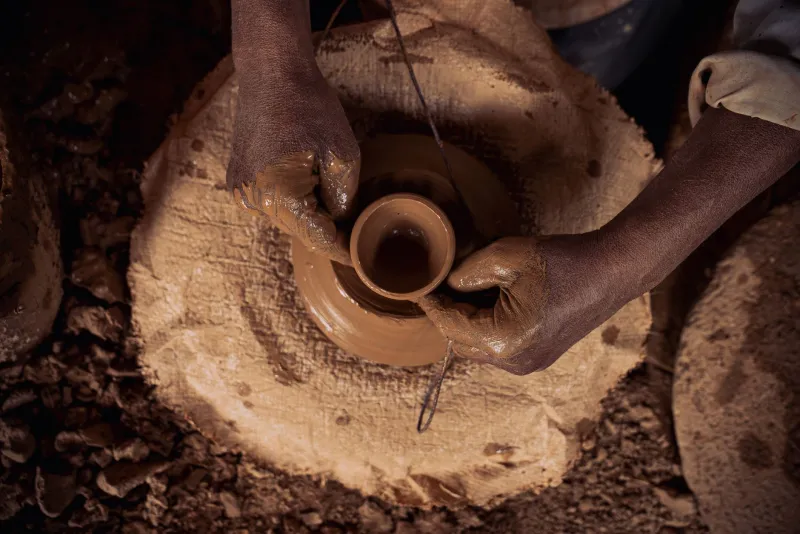
Let's get the uncomfortable part out of the way first: ethical consumption costs more up front. A hand-thrown mug from a potter at my local Saturday market runs $32. A pack of six mugs at a big-box store runs the same. My first month, I bought almost nothing, because I kept experiencing sticker shock and retreating to my kitchen to drink from chipped mugs I already owned.
Which, it turns out, was the first lesson: I already owned enough.
The first two months of the experiment weren't really a buying experiment at all. They were a using-what-I-have experiment. I repaired instead of replaced. I wore the same three sweaters. I finally used the nice candle I'd been saving for an occasion that never came.
If you try this, know that going in: the first couple months are less about shopping differently and more about confronting how much of your shopping was never necessary in the first place.
Waiting Became a Spiritual Practice
Here's something nobody tells you about buying handmade: you wait. The woodworker in Asheville has a six-week queue. The seamstress who made my winter coat needed two months and a follow-up email. The ceramicist's shop restocks on the first Friday of the month, and if you miss it, you miss it.
At first this drove me insane. I'm an American. I've been trained to believe that wanting a thing and receiving a thing should be separated by no more than 48 hours.
But somewhere around month four, the waiting started to feel different. When you put something on a list and sit with the wanting for six weeks, one of two things happens: either the desire deepens into genuine intention, or it dissolves entirely. Roughly half the things I 'needed' in March, I couldn't even remember by May.
Desire, it turns out, has a half-life. Convenience just keeps it on life support. Strip away the instant gratification and most of what we want simply... passes through us. The things that survive the wait are the things worth owning. This is the closest thing to a cheat code for consumption that I've ever found.
The Money Math Nobody Expects
I tracked every dollar. The results surprised me.
Yes, individual purchases cost more. But my total spending on 'stuff' dropped by roughly 40 percent compared to the year before. Why? Because handmade and secondhand purchases are deliberate. There's no checkout-aisle impulse buy at a craft fair. There's no 'add to cart to get free shipping' manipulation when you're buying a quilt from a woman in Georgia you've exchanged three emails with.
I bought fewer things — maybe a third of what I used to — and every single one of them still gets used. My old life was full of $8 purchases that added up to nothing. This life is full of $80 purchases that I use weekly and will use for a decade.
The financial trade-off, honestly, was less about money and more about rhythm. Instead of a constant drip of small spending, my purchases came in intentional waves. I saved for them. And weirdly, saving for a specific thing made by a specific person felt completely different from the abstract, joyless act of 'budgeting.'
What I Bought, and What It Gave Back
A refurbished cast iron skillet from an estate sale that cooks better than anything new. A wool blanket made by a cooperative of weavers, which cost as much as a utility bill and is worth every degree. A hand-carved wooden spoon that makes cooking dinner feel like a small ceremony instead of a chore.
And relationships, which I did not see coming. I know the people who made most of the things in my home now. When my potter friend had a kiln failure, I felt it. When the weaver posted her new pattern, I cared. My consumption stopped being anonymous, and once it did, it stopped being careless. You don't treat a person's two weeks of labor like a disposable object.
This is what we're always talking about here at Dharmatala Market: commerce used to be a web of relationships, not a vending machine. Spend one year on the other side of it and you can't un-know that.
If You Want to Try Your Own Version
You don't need my exact rules. Start here:
- Do a 60-day buy-nothing sprint first. Learn what you actually use before you spend a dime.
- Build a 'wait list,' not a wish list. Nothing gets purchased for 30 days. Watch half of it evaporate.
- Find your people early. Local craft fairs, farmers markets, estate sales, one or two trusted online marketplaces. The hunting gets easier when you know where to look.
- Give yourself a repair budget. Fixing what you own is the most artisanal purchase of all.
- Expect the backslide. I bought a machine-made umbrella in a rainstorm in October. Forgive yourself and keep going. Rigidity isn't the point — attention is.
A Year Later, the Deepest Shift
The stuff is nice. The money habits are better. But the real change is quieter than that: I trust my own wanting now. I know the difference between a hunger fed by a notification and a genuine pull toward something beautiful, useful, and made by human hands.
Convenience is a fine servant and a terrible teacher. Take it out of the equation for a year, and you learn what you actually need — which, for most of us, is so much less than we thought, and so much more meaningful when it finally arrives.